1125) CAN CHEAPER LATTE AND STARTING THE DAY EARLY SOLVE KL's PERPETUAL TRAFFIC JAMS? - THE STRAITS TIMES - 16/04/2026
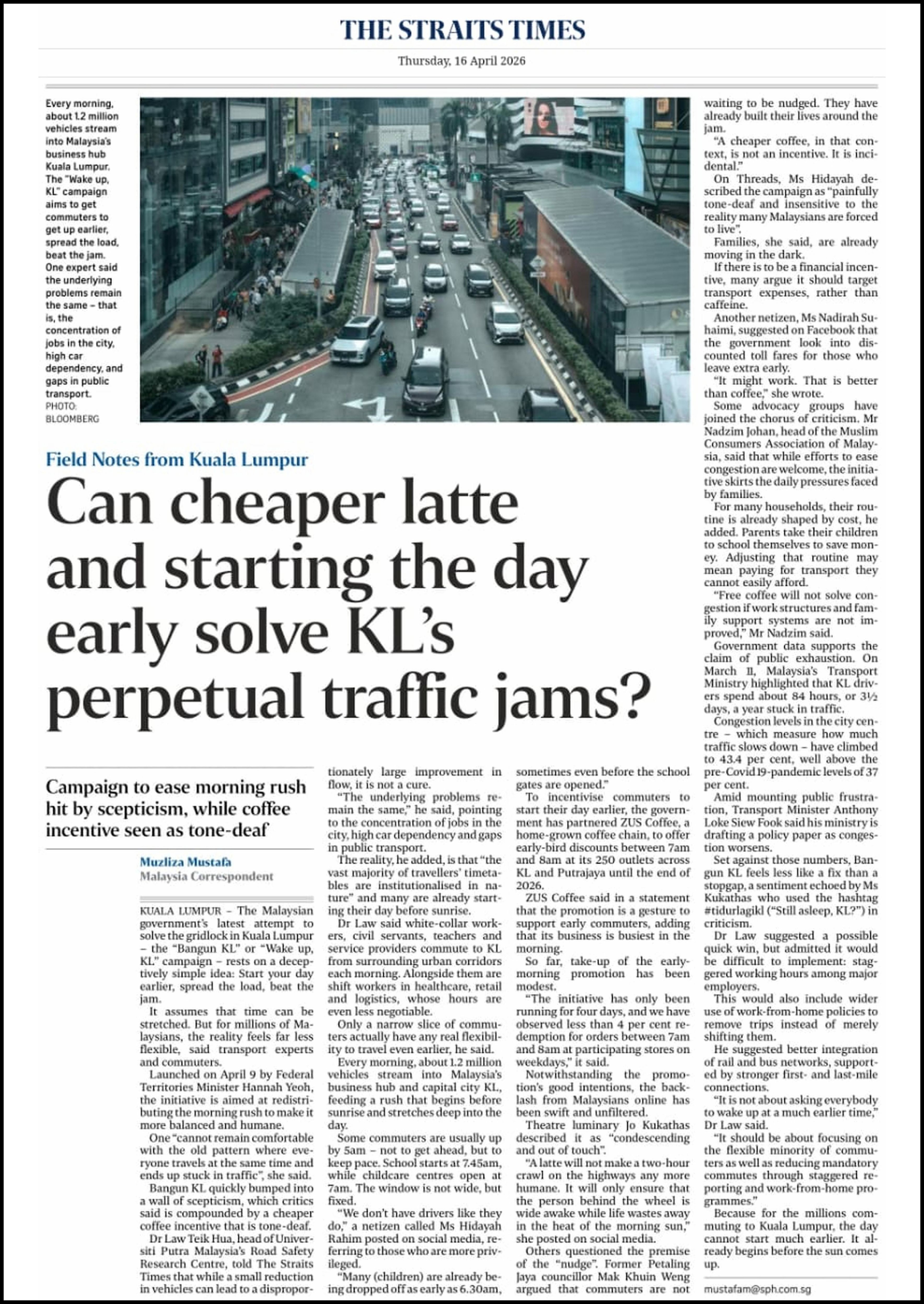
KUALA LUMPUR – The Malaysian government’s latest attempt to solve the gridlock in Kuala Lumpur – the “Bangun KL” or “Wake up, KL” campaign – rests on a deceptively simple idea: Start your day earlier, spread the load, beat the jam.
It assumes that time can be stretched. But for millions of Malaysians, the reality feels far less flexible, said transport experts and commuters.
Launched on April 9 by Federal Territories Minister Hannah Yeoh, the initiative is aimed at redistributing the morning rush to make it more balanced and humane.
One “cannot remain comfortable with the old pattern where everyone travels at the same time and ends up stuck in traffic”, she said.
Bangun KL quickly bumped into a wall of scepticism, which critics said is compounded by a cheaper coffee incentive that is tone-deaf.
Dr Law Teik Hua, head of Universiti Putra Malaysia’s Road Safety Research Centre, told The Straits Times that while a small reduction in vehicles can lead to a disproportionately large improvement in flow, it is not a cure.
“The underlying problems remain the same,” he said, pointing to the concentration of jobs in the city, high car dependency and gaps in public transport.
The reality, he added, is that “the vast majority of travellers’ timetables are institutionalised in nature” and many are already starting their day before sunrise.
Dr Law said white-collar workers, civil servants, teachers and service providers commute to KL from surrounding urban corridors each morning. Alongside them are shift workers in healthcare, retail and logistics, whose hours are even less negotiable.
Only a narrow slice of commuters actually have any real flexibility to travel even earlier, he said.
Cheaper coffee won’t help
Every morning, about 1.2 million vehicles stream into Malaysia’s business hub and capital city KL, feeding a rush that begins before sunrise and stretches deep into the day.
Some commuters are usually up by 5am – not to get ahead, but to keep pace. School starts at 7.45am, while childcare centres open at 7am. The window is not wide, but fixed.
“We don’t have drivers like they do,” a netizen called Ms Hidayah Rahim posted on social media, referring to those who are more privileged.
“Many (children) are already being dropped off as early as 6.30am, sometimes even before the school gates are opened.”
To incentivise commuters to start their day earlier, the government has partnered ZUS Coffee, a home-grown coffee chain, to offer early-bird discounts between 7am and 8am at its 250 outlets across KL and Putrajaya until the end of 2026.

ZUS Coffee said in a statement that the promotion is a gesture to support early commuters, adding that its business is busiest in the morning.
So far, take-up of the early-morning promotion has been modest.
“The initiative has only been running for four days, and we have observed less than 4 per cent redemption for orders between 7am and 8am at participating stores on weekdays,” it said.
Notwithstanding the promotion’s good intentions, the backlash from Malaysians online has been swift and unfiltered.
Theatre luminary Jo Kukathas described it as “condescending and out of touch”.
“A latte will not make a two-hour crawl on the highways any more humane. It will only ensure that the person behind the wheel is wide awake while life wastes away in the heat of the morning sun,” she posted on social media.
Others questioned the premise of the “nudge”. Former Petaling Jaya councillor Mak Khuin Weng argued that commuters are not waiting to be nudged. They have already built their lives around the jam.
“A cheaper coffee, in that context, is not an incentive. It is incidental.”
On Threads, Ms Hidayah described the campaign as “painfully tone-deaf and insensitive to the reality many Malaysians are forced to live”.
Families, she said, are already moving in the dark.
If there is to be a financial incentive, many argue it should target transport expenses, rather than caffeine.
netizen, Ms Nadirah Suhaimi, suggested on Facebook that the government look into discounted toll fares for those who leave extra early.
“It might work. That is better than coffee,” she wrote.
Families bear the brunt of congestion
Some advocacy groups have joined the chorus of criticism. Mr Nadzim Johan, head of the Muslim Consumers Association of Malaysia, said that while efforts to ease congestion are welcome, the initiative skirts the daily pressures faced by families.
For many households, their routine is already shaped by cost, he added. Parents take their children to school themselves to save money. Adjusting that routine may mean paying for transport they cannot easily afford.
“Free coffee will not solve congestion if work structures and family support systems are not improved,” Mr Nadzim said.

Government data supports the claim of public exhaustion. On March 11, Malaysia’s Transport Ministry highlighted that KL drivers spend about 84 hours, or 3½ days, a year stuck in trafic.
Congestion levels in the city centre – which measure how much traffic slows down – have climbed to 43.4 per cent, well above the pre-Covid 19-pandemic levels of 37 per cent.
Amid mounting public frustration, Transport Minister Anthony Loke Siew Fook said his ministry is drafting a policy paper as congestion worsens.
Set against those numbers, Bangun KL feels less like a fix than a stopgap, a sentiment echoed by Ms Kukathas who used the hashtag #tidurlagikl (“Still asleep, KL?”) in criticism.
Dr Law suggested a possible quick win, but admitted it would be difficult to implement: staggered working hours among major employers.
This would also include wider use of work-from-home policies to remove trips instead of merely shifting them.
He suggested better integration of rail and bus networks, supported by stronger first- and last-mile connections.
“It is not about asking everybody to wake up at a much earlier time,” Dr Law said.
“It should be about focusing on the flexible minority of commuters as well as reducing mandatory commutes through staggered reporting and work-from-home programmes.”
Because for the millions commuting to Kuala Lumpur, the day cannot start much earlier. It already begins before the sun comes up.
Muzliza Mustafa is The Straits Times’ Malaysia Correspondent based in Kuala Lumpur.
Article by: The Straits Times (Singapore)
CAN CHEAPER LATTE AND STARTING THE DAY EARLY SOLVE KL's PERPETUAL TRAFFIC JAMS?